
The artificial intelligence marketing automation landscape has undergone a revolutionary transformation in 2025, with the global marketing automation software market growing from $7.15 billion in 2024 to $8.23 billion in 2025, representing a compound annual growth rate (CAGR) of 15.2%. This explosive growth reflects the increasing demand from businesses seeking to streamline their marketing processes, enhance customer engagement, and drive revenue growth through intelligent automation. With 84% of marketing organizations now using AI in some form and 91% of top-performing marketers reporting AI usage in their campaigns, AI-powered marketing automation has become essential rather than optional.
For businesses navigating this rapidly evolving landscape, understanding which AI marketing automation tools best align with their specific needs has become crucial for maintaining competitive advantage. This comprehensive guide explores the leading AI marketing automation platforms of 2025, examining their unique features, strengths, and ideal use cases to help you make an informed decision about which tools can best power your marketing strategy.
The AI Marketing Automation Revolution: Market Overview
The marketing automation software market is projected to maintain its strong growth trajectory, reaching $14.73 billion by 2029 with a CAGR of 15.7%. This remarkable expansion is driven by several key factors, including the increasing need for personalized customer experiences, the emergence of influencer marketing, and the growing significance of customer journey mapping. The integration of artificial intelligence has fundamentally transformed what marketing automation can accomplish, with AI-powered tools now capable of tasks that would have been impossible just a few years ago.
Key market trends shaping the AI marketing automation landscape in 2025 include:
- Integration with customer service platforms: Marketing automation tools are increasingly connecting with customer support systems to create seamless customer experiences across all touchpoints.
- Shift toward account-based marketing: Platforms are evolving to support highly targeted, personalized marketing campaigns directed at specific high-value accounts.
- Data management integration: Marketing automation tools are developing deeper connections with data management platforms to leverage customer data more effectively.
- Sales automation alignment: Marketing and sales automation tools are becoming more tightly integrated, creating unified revenue operations systems.
The impact of these AI-powered marketing automation tools is substantial, with companies using AI in marketing reducing operational costs by 20% on average while simultaneously improving decision-making accuracy for 82% of marketers. As we examine the top tools in this space, we’ll see how they’re leveraging these trends to deliver unprecedented value to marketers.
Top AI Marketing Automation Tools of 2025
1. Zapier – The Integration Powerhouse
Best for: Cross-platform automation, workflow orchestration, and no-code marketing integrations
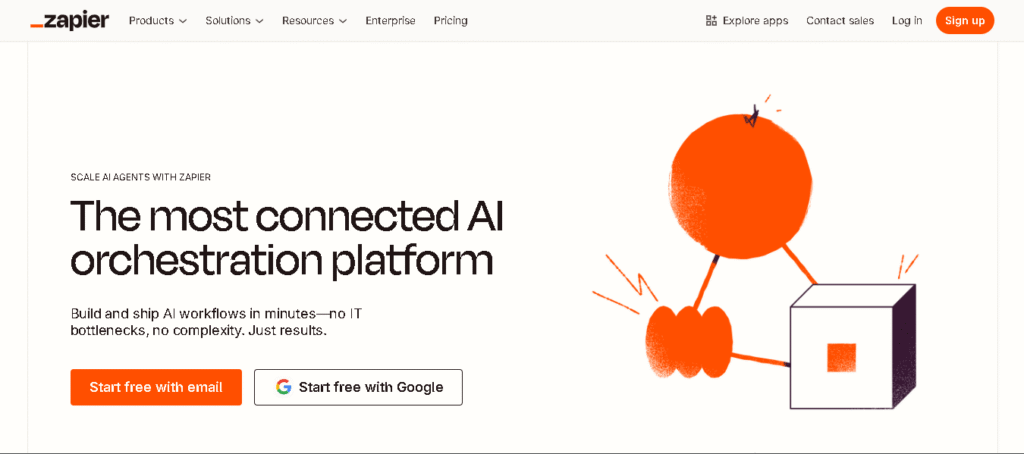
Zapier has evolved from a simple automation tool to a comprehensive AI-powered marketing ecosystem in 2025. The platform’s strength lies in its ability to connect thousands of apps with no coding knowledge required, creating seamless workflows across the entire marketing technology stack.
Key AI Features:
- Zapier Copilot: AI-powered assistant that helps build automations by simply describing what you want to accomplish in natural language.
- AI by Zapier: Integration with OpenAI and other AI models to power intelligent workflows across marketing platforms.
- Zapier Agents: Custom AI agents that can perform complex marketing tasks autonomously, from lead qualification to content distribution.
- Zapier Chatbots: Shareable AI chatbots that can be trained on your marketing knowledge base to engage with prospects and customers.
- Zapier Interfaces: No-code tools for creating forms, landing pages, and customer portals with embedded AI capabilities.
Pricing Structure:
- Free Plan: Unlimited Zaps, AI power-ups, 5 tables, 2 interfaces, and 2 chatbots.
- Paid Plans: Starting at $19.99/month (billed annually) for advanced features like multi-step Zaps and access to advanced AI models.
Zapier’s competitive advantage lies in its ability to orchestrate complex, interconnected marketing workflows with efficiency and ease, regardless of business size or budget. The platform’s AI-powered automation strategies enable sophisticated marketing processes like lead scoring, email copywriting, and content creation without requiring technical expertise.
2. ActiveCampaign – The AI-First Marketing Platform
Best for: Email marketing automation, customer experience automation, and AI-driven personalization
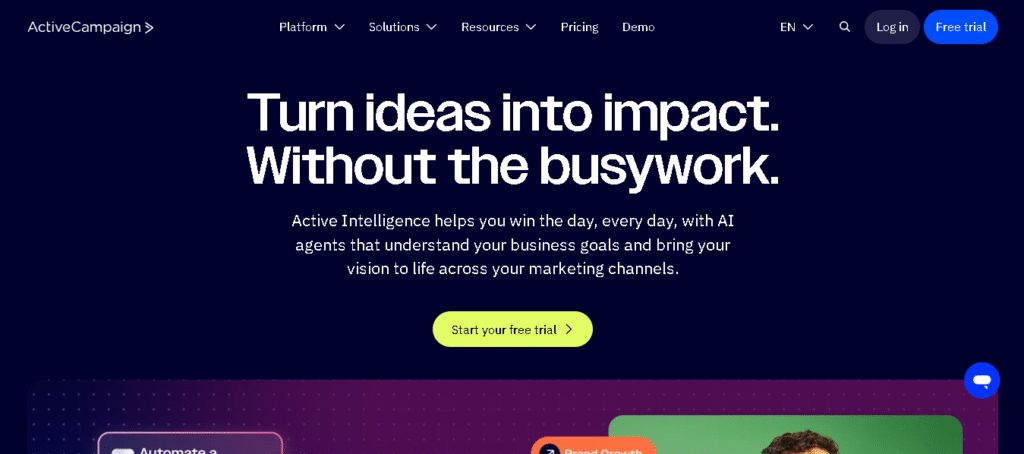
ActiveCampaign has positioned itself as a leader in AI-powered marketing automation with its 2025 launch of Active Intelligence, a comprehensive AI-first marketing orchestration platform. The system enables marketers to set goals and delegate routine tasks to a “behind-the-scenes AI team” that can build entire personalized, cross-channel campaigns automatically.
Advanced AI Features:
- AI Campaign Builder: Creates complete email campaigns including subject lines, preheaders, layouts, images, content, and calls-to-action using simple prompts.
- AI Automation Agent: Develops personalized content and messaging tailored to specific contacts to maximize conversions.
- AI Brand Kit: Automatically incorporates brand identity into every campaign for consistent templates, images, and content.
- Predictive Sending: Determines the optimal sending time for each contact based on previous engagement patterns.
- Suggested Segments: Offers data-backed recommendations on high-value customer segments and how to engage them effectively.
Pricing and Accessibility:
ActiveCampaign offers tiered pricing based on contact list size and feature requirements, with plans designed for businesses of all sizes from small startups to enterprise organizations.
The platform’s strength lies in its comprehensive approach to marketing automation, combining AI-powered content creation, customer segmentation, and campaign optimization in a unified system. Users report significant performance improvements, with one early adopter stating that Active Intelligence “has been one of the most transformative changes” in their career, helping triple their sales volume.
3. HubSpot Marketing Automation – The All-In-One Marketing Solution
Best for: Integrated marketing, sales, and service automation with powerful AI capabilities
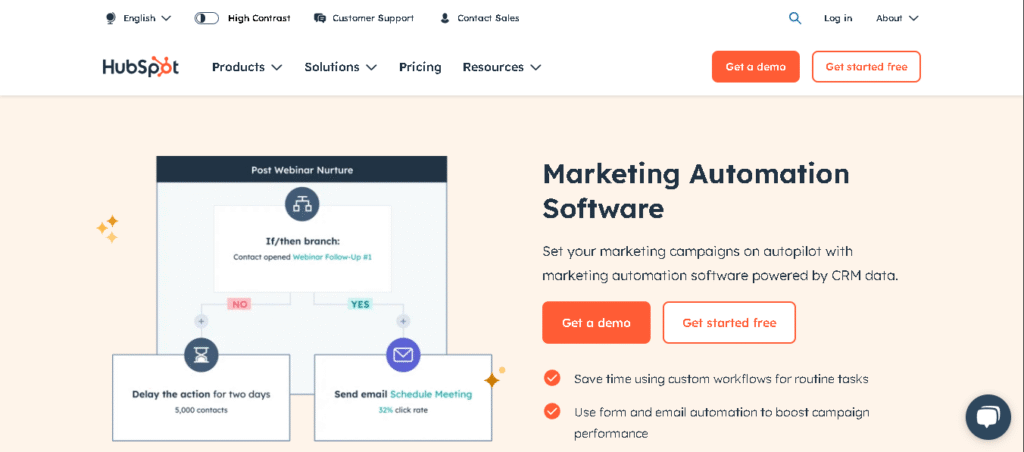
HubSpot’s marketing automation functionality remains one of the most powerful and popular tools in 2025, offering a comprehensive growth suite that includes sales, marketing, and support software all integrated with HubSpot’s CRM. This unified approach creates unique automation possibilities that would be difficult or impossible with separate tools.
Key AI Features:
- AI-Powered Workflows: Visual workflow builder with conditional logic and AI-driven optimization.
- AI Email Writer: Generates email content in a fraction of the time based on campaign goals and brand voice.
- AI Social Caption Generator: Creates engaging copy for social media posts automatically.
- Intelligent Chatbots: Conversational AI that engages website visitors and qualifies leads.
- Lead Scoring and Journey Orchestration: AI-driven lead prioritization and personalized customer journeys.
Pricing Structure:
- Free Tier: Basic email and form marketing automation tools.
- Paid Plans: Starting at $15 per user/month with increasing access to advanced features.
HubSpot’s competitive advantage comes from its unified data approach, with all marketing, sales, and service information stored in a single CRM system. This creates a 360-degree view of each customer that powers more effective automation and personalization. According to HubSpot, 57% of Marketing Hub customers saw an increase in leads generated with their marketing campaigns after implementing the platform.
4. Salesforce Marketing Cloud – The Enterprise AI Solution
Best for: Large organizations, complex marketing operations, and advanced AI-driven customer journeys
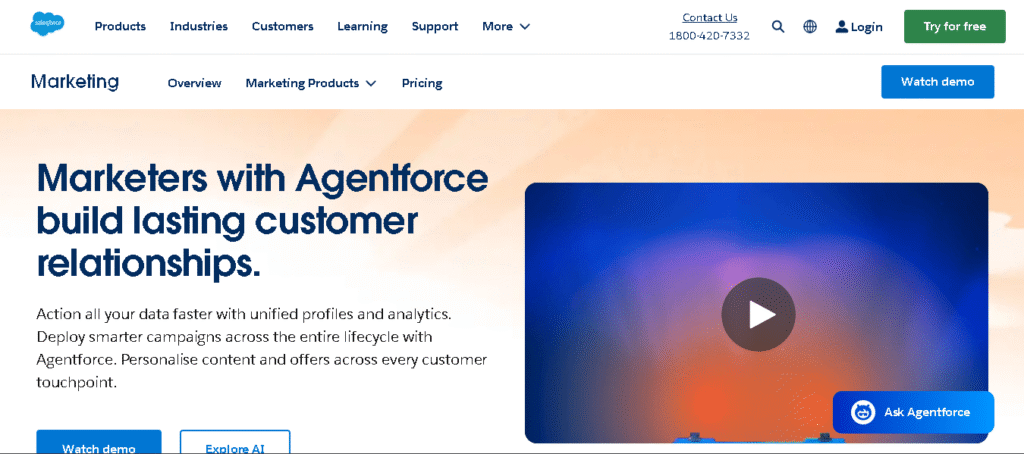
Salesforce Marketing Cloud has established itself as the enterprise standard for AI-powered marketing automation in 2025, with its introduction of Marketing Cloud Advanced and Agentforce for Marketing. These innovations connect marketing journeys with sales, service, and commerce workflows to personalize every customer interaction point.
Advanced AI Capabilities:
- Agentforce for Marketing: AI agents that plan, launch, and optimize end-to-end marketing campaigns based on defined goals and brand guidelines.
- Einstein Marketing Intelligence: Automated data preparation, harmonization, and cross-channel campaign performance optimization.
- Einstein Engagement Scoring: AI-powered analysis of subscriber engagement to target the most active prospects.
- Einstein Designer: Creates relevant content in seconds using variations of available images, copy, and headlines.
- Interaction Studio Templates: Delivers personalized interactions across channels including ATMs, point-of-sale systems, and call centers.
Enterprise Integration:
Salesforce Marketing Cloud’s strength lies in its deep integration with the broader Salesforce ecosystem, creating a unified view of the customer across marketing, sales, service, and commerce. As Steve Hammond, Executive Vice President and General Manager of Marketing Cloud at Salesforce, explains: “Marketing Cloud, built on Data Cloud, is the only solution that connects every department and every moment across the entire customer lifecycle with unified data, Agentforce Agents, and powerful automation”.
5. Mailchimp – The Small Business AI Marketing Solution
Best for: Small to medium businesses, email marketing automation, and AI-assisted content creation
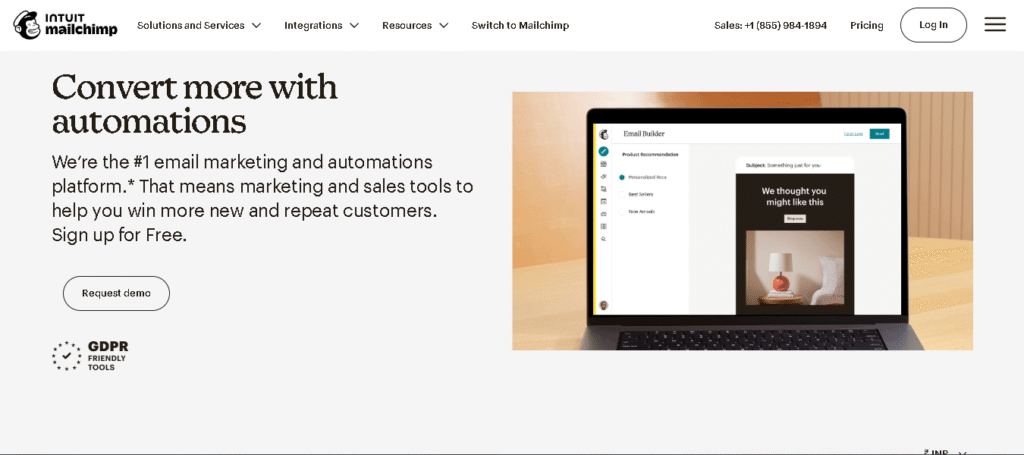
Mailchimp has evolved beyond simple email marketing to become a comprehensive AI-powered marketing platform in 2025, with the introduction of Intuit Assist working across Mailchimp to help marketers tackle manual tasks and produce personalized content at scale. The platform now offers over 150 new and updated features designed to help marketers save time and accelerate growth.
Key AI Features:
- AI-Generated Automations: Welcome new contacts, recover abandoned carts, and win back lost customers with AI-generated automations and fully-built emails.
- Predictive Customer Insights: AI models that predict which customers are most likely to convert and help target them with personalized content.
- Intuit Assist Content Generation: AI-powered email writing that generates on-brand emails and copy that only need review and editing.
- Content Recommendations: Analyzes campaigns and provides personalized suggestions for improvement.
- AI Design Generation: Creates custom designs using brand colors, fonts, logos, and images.
Market Position:
Mailchimp’s research found that 88% of marketers believe their organization must increase its use of automation and AI to meet customer expectations and stay competitive. The platform’s integration of AI into its core functionality addresses this need, with features like automated email content generation and predictive analytics making sophisticated marketing accessible to businesses without dedicated technical teams.
6. Klaviyo – The E-commerce Marketing Automation Specialist
Best for: E-commerce businesses, customer segmentation, and revenue-driving automation
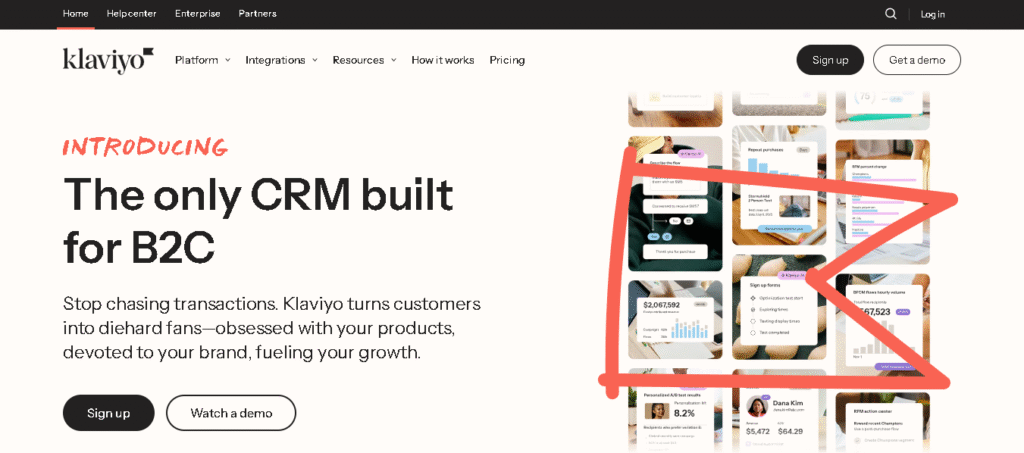
Klaviyo has positioned itself as the leading AI-powered marketing automation platform for e-commerce businesses in 2025, with the launch of Klaviyo AI designed to unlock revenue-driving opportunities and deliver exceptional customer experiences across channels. The platform’s focus on data-driven marketing makes it particularly valuable for online retailers seeking to maximize customer lifetime value.
Advanced AI Features:
- Segments AI: Generates complex customer segments in seconds based on simple audience prompts.
- Email AI: Creates high-performing email content by inputting campaign goals and generating on-brand emails instantly.
- Forms AI: Optimizes web forms for conversion by testing multiple versions to find the highest-converting display time.
- Predictive Analytics: Forecasts next order date, lifetime value, spending potential, and predicted demographics to deliver relevant experiences.
AI Evolution:
As Andrew Bialecki, co-founder and CEO of Klaviyo, explains: “AI has always been ingrained in our DNA. We started with predictive analytics, to help anticipate consumer needs. We then expanded into generative capabilities to streamline work and accelerate content creation. Now we’re focused on autonomous AI, and creating a platform that continuously learns and adapts, refining strategies for the best outcomes in a fraction of the time”.
7. Omnisend – The Omnichannel Marketing Automation Platform
Best for: Multi-channel marketing, e-commerce automation, and AI-driven customer engagement
Omnisend has emerged as a powerful AI-powered omnichannel marketing automation platform that helps businesses streamline their marketing efforts across email, SMS, push notifications, WhatsApp, and Facebook Messenger. The platform’s strength lies in its ability to create personalized and targeted marketing campaigns across multiple channels simultaneously.
Key AI Features:
- AI-Powered Email Marketing: Creates and sends targeted email campaigns with personalized content and dynamic product recommendations.
- Automated SMS Marketing: Sends personalized SMS messages to subscribers to drive engagement and conversions.
- AI Cart Recovery: Automatically sends personalized messages to customers who abandon their shopping carts.
- Browse Abandonment Automation: Reminds customers of products they’ve viewed but not purchased with personalized messages.
- AI Product Recommendations: Uses AI to suggest personalized product recommendations based on each customer’s shopping behavior.
User Experience:
Omnisend offers an intuitive and easy-to-use interface with advanced segmentation for precise targeting and powerful email automation features. The platform provides detailed reports and analytics for campaign tracking and optimization, making it accessible to marketers without technical expertise.
Choosing the Right AI Marketing Automation Tool
Selecting the appropriate AI marketing automation tool depends on several factors that businesses should carefully consider to find the perfect fit for their specific needs and goals. Understanding your requirements, budget constraints, and growth objectives will help narrow down the options to identify the ideal platform.
For Business Size and Complexity
Different tools are optimized for businesses of varying sizes and operational complexity. Small businesses and solopreneurs might find Mailchimp or Omnisend’s user-friendly interfaces and affordable pricing most suitable. Mid-sized companies often benefit from the scalability and comprehensive features of ActiveCampaign or Klaviyo. Enterprise organizations with complex marketing operations typically require the advanced capabilities and integration options of Salesforce Marketing Cloud or HubSpot.
For Industry and Use Case
Industry-specific needs should influence platform selection. E-commerce businesses generally benefit most from platforms with strong product recommendation engines and cart abandonment features, such as Klaviyo or Omnisend. B2B companies often require robust lead scoring and nurturing capabilities found in HubSpot or Salesforce Marketing Cloud. Service-based businesses might prioritize appointment scheduling and follow-up automation available in ActiveCampaign.
For Integration Requirements
Consider your existing technology stack when choosing a marketing automation platform. Zapier offers unparalleled integration capabilities, connecting with thousands of apps to create seamless workflows across your entire tech ecosystem. HubSpot provides a comprehensive all-in-one solution that eliminates the need for many separate tools. Salesforce Marketing Cloud offers deep integration with the broader Salesforce platform, making it ideal for organizations already using Salesforce products.
Budget Considerations
AI marketing automation tools offer various pricing structures to accommodate different budgets. Many platforms provide free tiers or trials that allow businesses to test capabilities before committing to paid plans. Consider not just the initial cost but the long-term value and potential ROI when evaluating pricing. According to research, companies using AI in marketing reduce operational costs by 20% on average, making the investment worthwhile for many organizations.
Implementation Best Practices
Successfully implementing AI marketing automation requires a strategic approach that balances technical setup with marketing strategy. Following these best practices will help ensure a smooth transition and maximize the value of your chosen platform.
Start with Clear Goals
Before diving into any platform, define specific, measurable marketing objectives. Whether you’re focusing on lead generation, customer retention, or revenue growth, having clear goals will guide your implementation strategy and help measure success. This clarity helps avoid the overwhelming feeling that can come from too many automation options.
Build a Solid Data Foundation
AI marketing automation is only as good as the data it works with. Ensure your customer data is clean, organized, and accessible to your automation platform18. Implement proper data collection methods and consider how different data sources will integrate with your chosen tool. Remember that 73% of marketers now leverage AI for personalized content delivery, which requires high-quality customer data.
Start Simple and Scale
Begin with basic automation workflows and gradually increase complexity as you gain confidence and see results. Starting with email welcome sequences, basic lead scoring, or simple segmentation allows you to build a foundation for more sophisticated automation. This approach helps teams adapt to new processes while delivering immediate value.
Continuous Optimization
AI marketing automation is not a “set it and forget it” solution. Regularly review performance metrics, test different approaches, and refine your automation strategies based on results. The most successful implementations involve ongoing optimization and adaptation to changing market conditions and customer behaviors.
The Future of AI Marketing Automation
The AI marketing automation landscape continues to evolve rapidly, with several key trends shaping its future development. Understanding these emerging trends helps businesses prepare for the next wave of innovation and maintain competitive advantage.
Agentic AI Marketing
The rise of autonomous AI agents represents one of the most significant developments in marketing automation. These intelligent agents can independently execute complex marketing tasks, from content creation to campaign optimization, with minimal human oversight. Platforms like Zapier’s AI Agents and ActiveCampaign’s AI Campaign Builder exemplify this trend, allowing marketers to delegate entire workflows to AI systems.
Hyper-Personalization at Scale
AI is enabling unprecedented levels of personalization across all marketing channels. Advanced algorithms analyze vast amounts of customer data to deliver highly tailored experiences that would be impossible to create manually. With 73% of marketers now leveraging AI for personalized content delivery, this trend is accelerating as AI models become more sophisticated.
Predictive Marketing Analytics
The future of marketing automation lies in predictive rather than reactive approaches. AI systems are increasingly able to forecast customer behavior, identify emerging trends, and recommend proactive marketing strategies. Features like Klaviyo’s predictive analytics and ActiveCampaign’s Predictive Sending represent early implementations of this capability, which will continue to advance in coming years.
Conversational Marketing Integration
AI-powered conversational interfaces are becoming central to marketing automation strategies. Chatbots, voice assistants, and messaging platforms powered by sophisticated AI models are creating new channels for customer engagement and lead qualification. The integration of these conversational tools with broader marketing automation platforms represents a significant opportunity for businesses to enhance customer experiences.
Conclusion
The AI marketing automation landscape in 2025 offers unprecedented opportunities for businesses to enhance customer engagement, streamline marketing operations, and drive revenue growth through intelligent automation. From Zapier’s powerful integration capabilities to ActiveCampaign’s comprehensive AI-first approach, today’s leading platforms leverage artificial intelligence to transform what’s possible in marketing automation.
The key to success lies not in choosing the most advanced tool, but in selecting the platform that best aligns with your specific business needs, existing technology stack, and growth objectives. Whether you’re a small business looking for an accessible entry point or an enterprise organization requiring sophisticated capabilities, there’s an AI marketing automation solution designed for your requirements.
As the marketing automation software market continues its explosive growth toward $14.73 billion by 2029, early adoption of these AI-powered tools provides significant competitive advantages1. Businesses that effectively implement and optimize AI marketing automation will be well-positioned to deliver the personalized, relevant experiences that today’s customers expect while operating with greater efficiency and effectiveness than ever before.
The future belongs to marketers who can effectively collaborate with AI, using these powerful tools to amplify their creativity and strategic thinking while automating routine tasks. By starting with the right AI marketing automation platform and following implementation best practices, businesses can transform their marketing operations and achieve remarkable results in the AI-powered marketing landscape of 2025 and beyond.