
The artificial intelligence coding landscape has reached unprecedented maturity in 2025, with the global AI code tools market projected to grow from $6.7 billion in 2024 to $25.7 billion by 2030, representing a compound annual growth rate of 25.2%. Software developers employing generative AI tools can be up to 60% faster at writing and optimizing code, with documenting code times cut in half and refactoring time reduced to barely more than a third of the standard period. This comprehensive guide explores the leading AI coding assistants that are transforming software development workflows in 2025.
The AI Coding Revolution: Why It Matters
The adoption of AI coding tools has reached a critical mass, with 70% of more than 90,000 developers using or planning to use AI tools in their development process. Among those already using AI tools, 83% use ChatGPT and 56% use GitHub Copilot, making these the two most dominant platforms in the space. Developers turn to AI tools primarily to increase productivity (32.81%), speed up learning (25.15%), and become more efficient (24.96%).
The enterprise adoption is equally impressive, with more than 25% of AI developers reporting at least one enterprise AI application in production, and an additional 39% in various phases of testing. Over 76% of professional developers are already using or looking to use AI tools as part of their development process, signaling a fundamental shift in how software is built.
Top 10 AI Coding Assistants of 2025
1. GitHub Copilot – The Industry Standard
Best for: General-purpose coding, enterprise environments, and seamless IDE integration
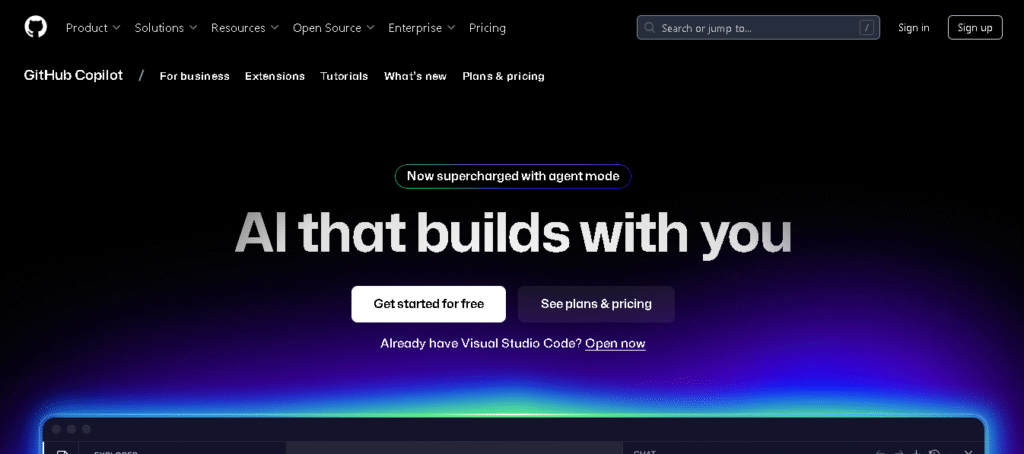
GitHub Copilot remains the most widely adopted AI coding assistant, serving over 15 million developers worldwide. Powered by OpenAI’s advanced models including GPT-4o and Codex, Copilot has evolved significantly since its initial release. The platform now offers sophisticated features including real-time code suggestions, auto-completions, and documentation generation across multiple programming languages.
Key Features:
- Advanced AI Models: Integration with GPT-4o, GPT-4.5, and specialized coding models
- Multi-IDE Support: Native integration with VS Code, Visual Studio, JetBrains, and Neovim
- Copilot Chat: Interactive coding assistance with natural language queries
- Code Explanation: Ability to explain complex code and suggest improvements
- Security Focus: Microsoft Responsible AI principles and enterprise-grade security
Pricing Structure:
- Free Tier: 50 agent mode or chat requests per month, 2,000 completions per month
- Pro Plan: $10/month with unlimited completions and chats
- Pro+ Plan: $39/month with 1,500 premium requests and access to latest models
- Business Plan: $19/month per user for organizations
- Enterprise Plan: Custom pricing with advanced features
GitHub’s strategic advantage lies in its deep integration with the development ecosystem and backing by Microsoft. The recent introduction of premium request limits reflects the higher computational costs of advanced models like Claude 3.5 Sonnet, but ensures sustainable access to cutting-edge AI capabilities.
2. Cursor AI – The AI-First Editor
Best for: Developers seeking a native AI-integrated development environment
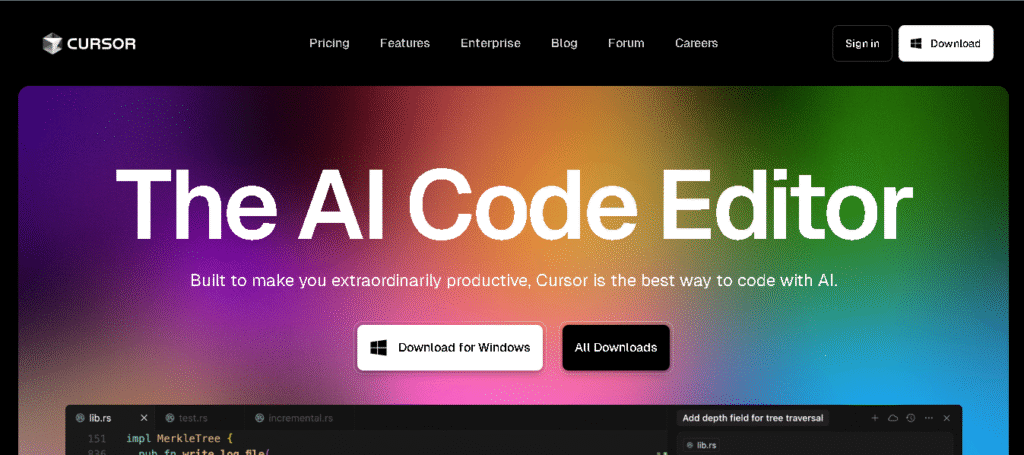
Cursor has emerged as a revolutionary AI-first code editor, built as a fork of VS Code with deep AI integration. Unlike traditional coding assistants that operate as plugins, Cursor provides a native AI experience that fundamentally reimagines how developers interact with code.
Key Features:
- Tab Prediction: Proprietary models that predict multi-line edits across files
- Agent Mode: End-to-end task completion with Ctrl+I command
- Codebase Understanding: Custom retrieval models for comprehensive project context
- Multi-file Editing: Simultaneous edits across multiple files with semantic understanding
- Smart Rewrites: Automatic code correction and optimization
Pricing Plans:
- Hobby Plan: Free with 2,000 completions and 50 premium requests
- Pro Plan: $20/month with unlimited completions and 500 fast premium requests
- Business Plan: $40/month with enterprise features and SSO integration
Cursor’s competitive advantage lies in its agent-based approach, where AI can complete entire tasks rather than just suggesting code snippets. The platform’s ability to understand project context and perform multi-file refactoring makes it particularly valuable for complex software projects.
3. Amazon Q Developer – The Cloud-Native Champion
Best for: AWS-focused development and cloud-native applications
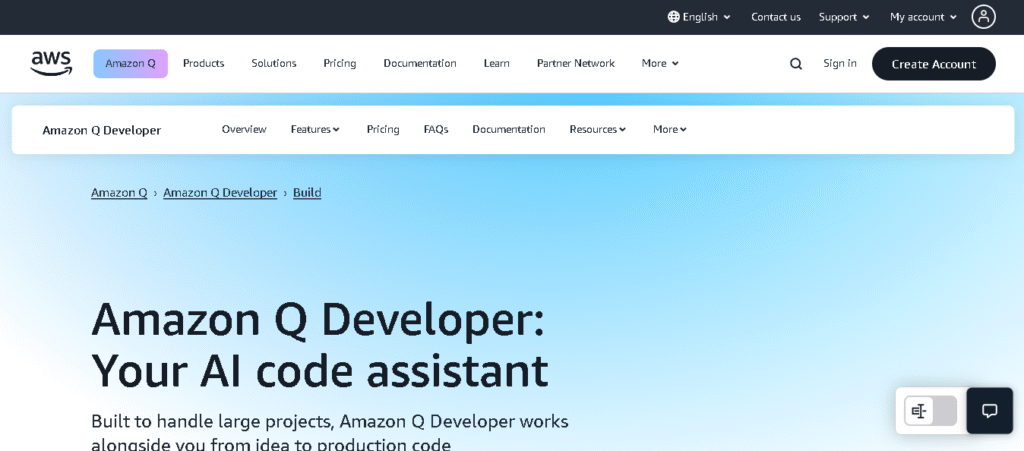
Amazon’s rebranded CodeWhisperer, now called Q Developer, specializes in cloud-native development with deep AWS integration. The platform offers natural language interaction to create code and architecture, with a security-first approach that includes built-in vulnerability scanning.
Key Features:
- AWS Integration: Native support for Lambda, S3, DynamoDB, and other AWS services
- Security Scanning: Built-in vulnerability detection and code security analysis
- Natural Language Processing: Convert plain English descriptions into AWS infrastructure code
- Code Transformation: Automated migration and modernization capabilities
Amazon Q Developer’s strength lies in its specialized focus on cloud development, making it indispensable for teams building on AWS infrastructure. The platform’s ability to generate both application code and infrastructure-as-code templates streamlines the entire cloud development lifecycle.
4. Tabnine – The Privacy-Focused Assistant
Best for: Enterprise teams prioritizing code privacy and security
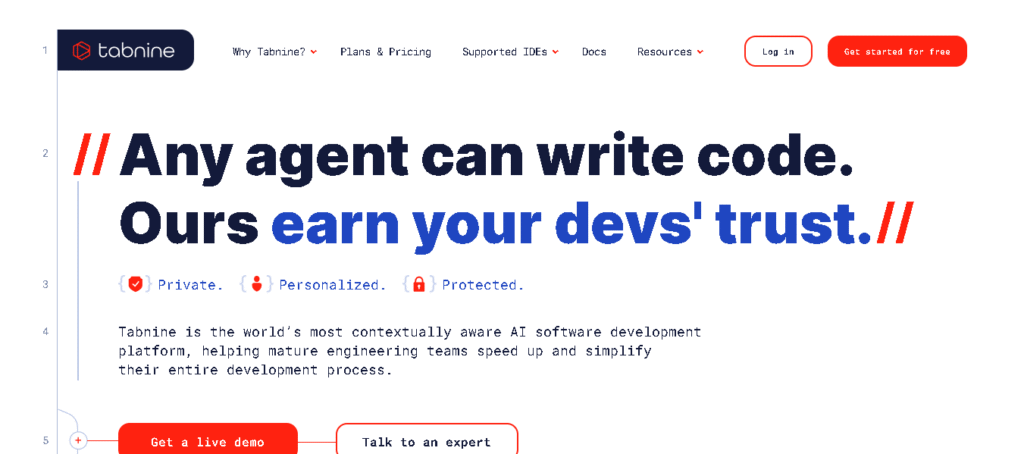
Tabnine distinguishes itself through its privacy-first approach, offering local deployment options that ensure sensitive code never leaves the organization’s infrastructure. The platform supports over 30 programming languages and integrates with all major IDEs.
Key Features:
- Local Deployment: On-premises models for maximum data privacy
- Code Personalization: AI learns and adapts to team coding patterns
- Multi-Language Support: Support for 80+ programming languages and frameworks
- Enterprise Security: SOC2 and GDPR compliance with advanced access controls
Pricing:
- Basic Plan: $9/month per user with essential features
- Pro Plan: Advanced features with team collaboration tools
Tabnine is trusted by more than 1,000,000 developers across thousands of organizations, making it one of the most widely deployed enterprise AI coding solutions.
5. Codeium – The Free Alternative
Best for: Individual developers and small teams seeking powerful free AI assistance
Codeium offers one of the most generous free tiers in the AI coding space, supporting over 70 programming languages with flexible deployment options. The platform provides rapid code autocomplete, intelligent search, and multiple editor support.
Key Features:
- Extensive Language Support: 70+ programming languages and frameworks
- Free Tier: Comprehensive features at no cost for individual users
- End-to-End Data Encryption: Security-focused architecture with SOC2 certification
- Flexible Deployment: Cloud, on-premises, and hybrid deployment options
Codeium’s competitive advantage is its commitment to providing enterprise-grade AI coding assistance without the enterprise price tag, making advanced AI accessible to developers regardless of budget constraints.
6. Sourcegraph Cody – The Context-Aware Assistant
Best for: Large codebases requiring deep contextual understanding
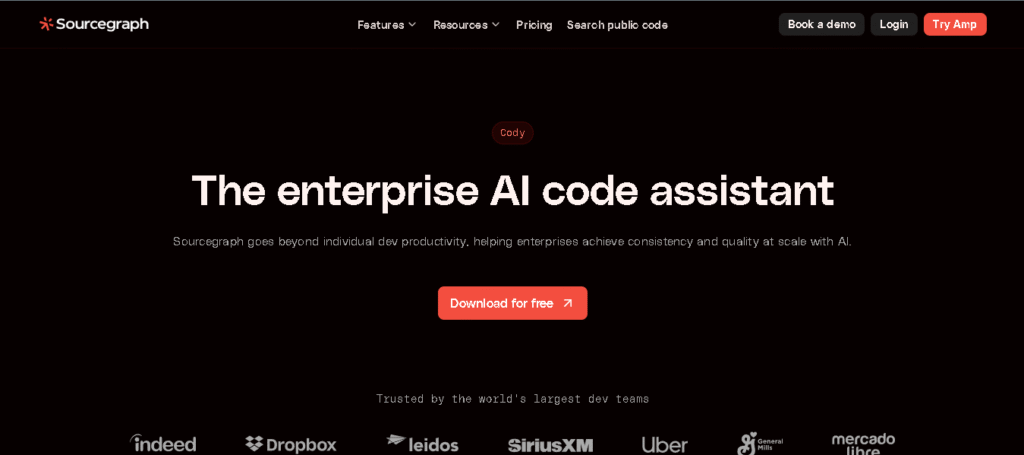
Cody leverages Sourcegraph’s advanced search API to provide extensive context from both local and remote codebases. The platform uses the latest LLMs while maintaining strict data privacy controls for enterprise users.
Key Features:
- Advanced Context: Deep codebase understanding using Sourcegraph’s search technology
- Multiple LLM Support: Access to GPT-4, Claude, and other leading models
- Code Explanations: Detailed explanations of code functionality and suggestions
- Enterprise Security: Zero code retention and training policies
Cody’s strength lies in its ability to understand complex, multi-repository codebases, making it particularly valuable for large organizations with extensive software portfolios.
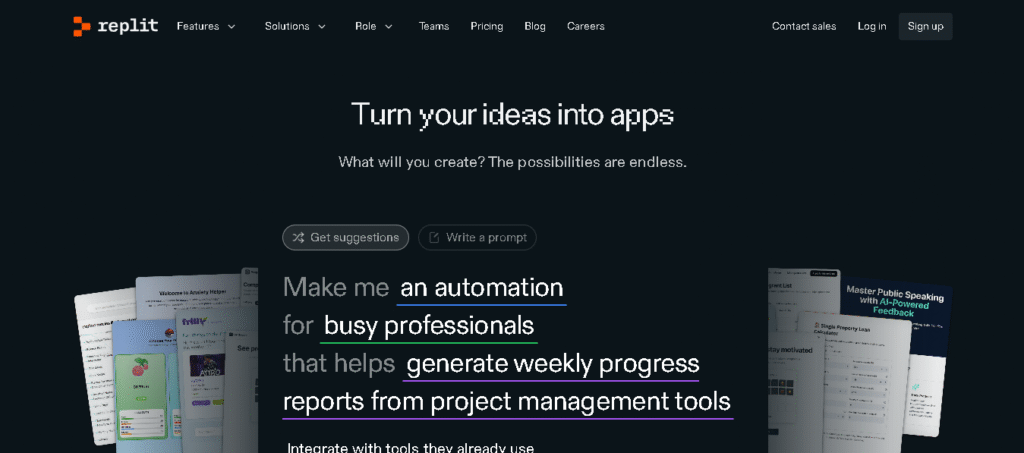
7. Replit Agent – The Full-Stack Builder
Best for: Rapid prototyping and full-stack web application development
Replit has evolved beyond a simple online IDE to become a comprehensive AI-powered development platform. The platform enables developers to build sophisticated applications through natural language prompts, handling everything from environment setup to deployment.
Key Features:
- Natural Language Development: Build applications by describing features in plain English
- Multi-file Intelligence: Coordinated changes across entire projects automatically
- Cloud-Based Environment: Full development environment accessible from any device
- Instant Deployment: One-click deployment directly from the development environment
Replit’s browser-based approach eliminates the need for local development environment setup, making it particularly attractive for educational use cases and rapid prototyping.
8. Windsurf – The Rising Star
Best for: Modern web development with design integration
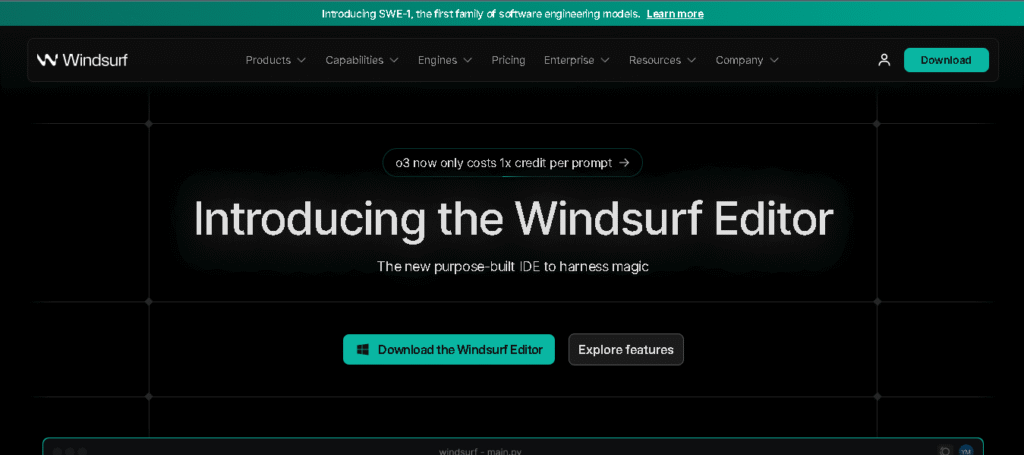
Windsurf has gained attention as an advanced AI-powered development assistant with smart autocompletion and real-time code analysis. The platform offers seamless integration with existing development workflows and includes unique features like Figma integration.
Key Features:
- AI-Powered Autocompletion: Context-aware code suggestions that adapt to coding style
- Real-Time Analysis: Dynamic error detection and code optimization
- Figma Integration: Direct import of design specifications into code
- Multi-Language Support: Comprehensive support for modern programming languages
Windsurf represents the new generation of AI coding tools that bridge the gap between design and development, making it particularly valuable for front-end developers and full-stack teams.
9. Blackbox AI – The Code Search Specialist
Best for: Code discovery and learning from existing codebases
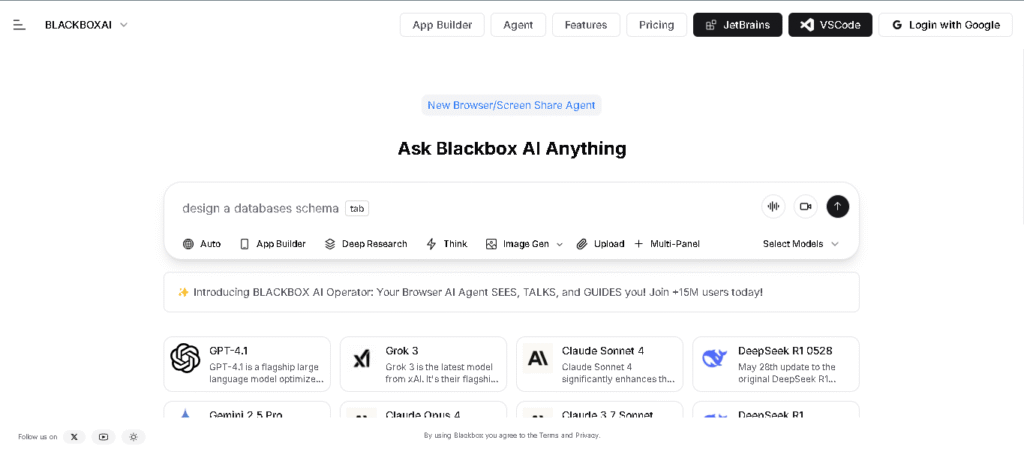
Blackbox AI specializes in searching and extracting code from various sources, including videos, PDFs, and repositories. The platform uses natural language processing and neural networks to understand code context and provide tailored suggestions.
Key Features:
- Code Extraction: Extract code from images, videos, and PDFs using OCR technology
- Multi-Source Search: Search across multiple programming languages and repositories
- Offline Capability: Local processing for enhanced performance and privacy
- Language Translation: Convert code between different programming languages
Blackbox AI’s unique value proposition lies in its ability to make existing code more discoverable and accessible, helping developers learn from the vast repository of code available online.
10. Bolt.new – The Web Development Agent
Best for: Browser-based full-stack web development
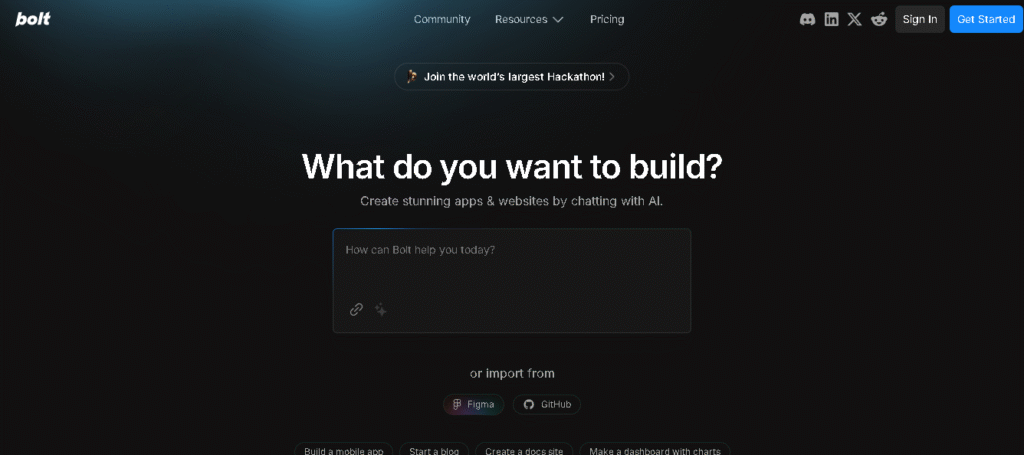
Bolt.new represents a new category of AI coding tools that provide complete development environments within the browser. Built by StackBlitz, the platform integrates cutting-edge AI models with WebContainers technology to enable full-stack development without local setup.
Key Features:
- Browser-Based Development: Complete development environment accessible via web browser
- Full-Stack Capabilities: Support for frontend, backend, and database development
- AI Agent Control: AI has complete control over filesystem, server, and deployment
- Integration Ecosystem: Built-in support for popular frameworks and third-party services
Bolt.new’s revolutionary approach eliminates the barriers between AI assistance and development environment control, enabling AI to manage the entire application lifecycle from creation to deployment.
Choosing the Right AI Coding Assistant
The selection of an AI coding assistant depends on several key factors that vary by individual needs and organizational requirements. Consider these critical decision points:
For Individual Developers
- Budget-conscious: Codeium offers comprehensive free features
- Privacy-focused: Tabnine provides local deployment options
- VS Code users: GitHub Copilot offers the most mature integration
- Experimental developers: Cursor provides cutting-edge AI-first experience
For Enterprise Teams
- AWS-centric: Amazon Q Developer offers specialized cloud development tools
- Large codebases: Sourcegraph Cody provides superior contextual understanding
- Security-critical: Tabnine and Codeium offer on-premises deployment
- Collaborative development: GitHub Copilot Business provides team management features
Programming Language Considerations
Different AI assistants excel with different programming languages. Python remains the most supported language across all platforms, followed by JavaScript, TypeScript, and Java. For specialized languages or frameworks, verify specific support before committing to a platform.
Security and Privacy Considerations
Enterprise adoption of AI coding assistants requires careful consideration of security and privacy implications. Key concerns include:
Data Privacy Risks
AI coding tools can inadvertently expose sensitive information through data leakage, inadequate anonymization, and third-party access. Organizations should implement data minimization practices, robust access controls, and regular audits of AI tool usage.
Code Training Policies
Enterprise customers should ensure that their code is never used for training AI models. Leading platforms like GitHub Copilot Business, Sourcegraph Cody Enterprise, and Tabnine offer explicit guarantees that customer code will not be used for model training.
Legal Considerations
The potential for AI-generated code to include copyrighted material remains a concern for enterprises. Organizations should implement code review processes and consider legal indemnification offerings from AI tool providers.
Market Trends and Future Outlook
The AI coding assistant market continues to evolve rapidly, with several key trends shaping the landscape:
Agentic AI Workflows
The majority (55%) of AI developers are now building agentic AI workflows, representing a shift from simple code completion to autonomous task execution. This trend is exemplified by tools like Cursor’s Agent mode and Bolt.new’s full-stack capabilities.
Model Specialization
AI coding assistants are increasingly using specialized models optimized for specific programming tasks. Claude 3.5 Sonnet has emerged as particularly strong for coding tasks, leading to rapid adoption by platforms like Cursor and Aider.
Enterprise Integration
The Microsoft-OpenAI partnership has established itself as the “IBM duo for the AI era,” providing enterprise customers with trusted, scalable AI coding solutions. This trend toward enterprise-grade solutions is driving increased investment in security, compliance, and deployment flexibility.
Performance and Productivity Impact
The productivity benefits of AI coding assistants are well-documented across multiple studies. Key performance improvements include:
- Code Generation: 40% reduction in time for writing new code
- Documentation: 50% reduction in time for documenting functionality
- Refactoring: Reduction to one-third of standard refactoring time
- Developer Satisfaction: 2x improvement in happiness and fulfillment when using AI tools
However, only 3% of developers highly trust the accuracy of AI-generated code, indicating that human oversight remains critical. The most successful implementations combine AI efficiency with human expertise and code review processes.
Implementation Best Practices
Successful adoption of AI coding assistants requires strategic implementation:
Getting Started
- Pilot Program: Begin with a small team using free or trial versions
- Training Investment: Provide developers with training on effective prompt engineering
- Workflow Integration: Gradually integrate AI tools into existing development processes
- Measurement: Track productivity metrics and code quality indicators
Scaling Up
- Enterprise Features: Evaluate security, compliance, and administrative requirements
- Team Standards: Establish guidelines for AI tool usage and code review
- Continuous Learning: Stay updated with new features and model improvements
Conclusion
The AI coding assistant landscape in 2025 offers unprecedented opportunities for developers and organizations to enhance productivity, code quality, and development velocity. From GitHub Copilot’s mature enterprise features to Cursor’s revolutionary AI-first approach, each platform brings unique strengths to different use cases and requirements.
The key to success lies in understanding your specific needs, whether that’s individual productivity enhancement, team collaboration, enterprise security, or specialized development requirements. As the market continues to mature, with the global AI code tools market expected to reach $25.7 billion by 2030, early adopters who thoughtfully integrate these tools will gain significant competitive advantages.
The future of software development is increasingly AI-assisted, but human creativity, oversight, and expertise remain essential. The most successful developers and organizations will be those who learn to effectively collaborate with AI, using these powerful tools to amplify their capabilities while maintaining the critical thinking and problem-solving skills that define great software engineering.
As we move forward, the integration of AI coding assistants will become not just advantageous but necessary for remaining competitive in the rapidly evolving software development landscape. The tools profiled in this guide represent the current state of the art, but continuous innovation ensures that even better solutions are on the horizon.


You really make it seem so easy with your presentation but I find this matter to be actually something that I think I would never understand. It seems too complicated and extremely broad for me. I’m looking forward for your next post, I’ll try to get the hang of it!